The clear five-stage approach to essential eight migration
Cyber security has become a critical business priority for organisations of all sizes. As threats continue to evolve and workplaces become increasingly connected, organisations need a security strategy that not only protects systems and data, but also supports operational efficiency, resilience and long-term growth.
For many organisations, achieving alignment with the Essential Eight is not a simple task. It often requires changes across infrastructure, applications, policies and user behaviour. Attempting to implement everything at once can quickly become complex, resource-intensive and disruptive, increasing the risk of gaps, poor adoption and inconsistent outcomes.
To make this journey more manageable, we’ve broken the process down into a clear five-stage approach. Each stage builds on the last, helping organisations understand their current security position, identify priorities and progressively strengthen their cyber security maturity. This structured pathway provides a practical and achievable route towards Essential Eight alignment, while minimising disruption and supporting lasting security improvements across the organisation.
The 5 Stage Essential Eight Approach
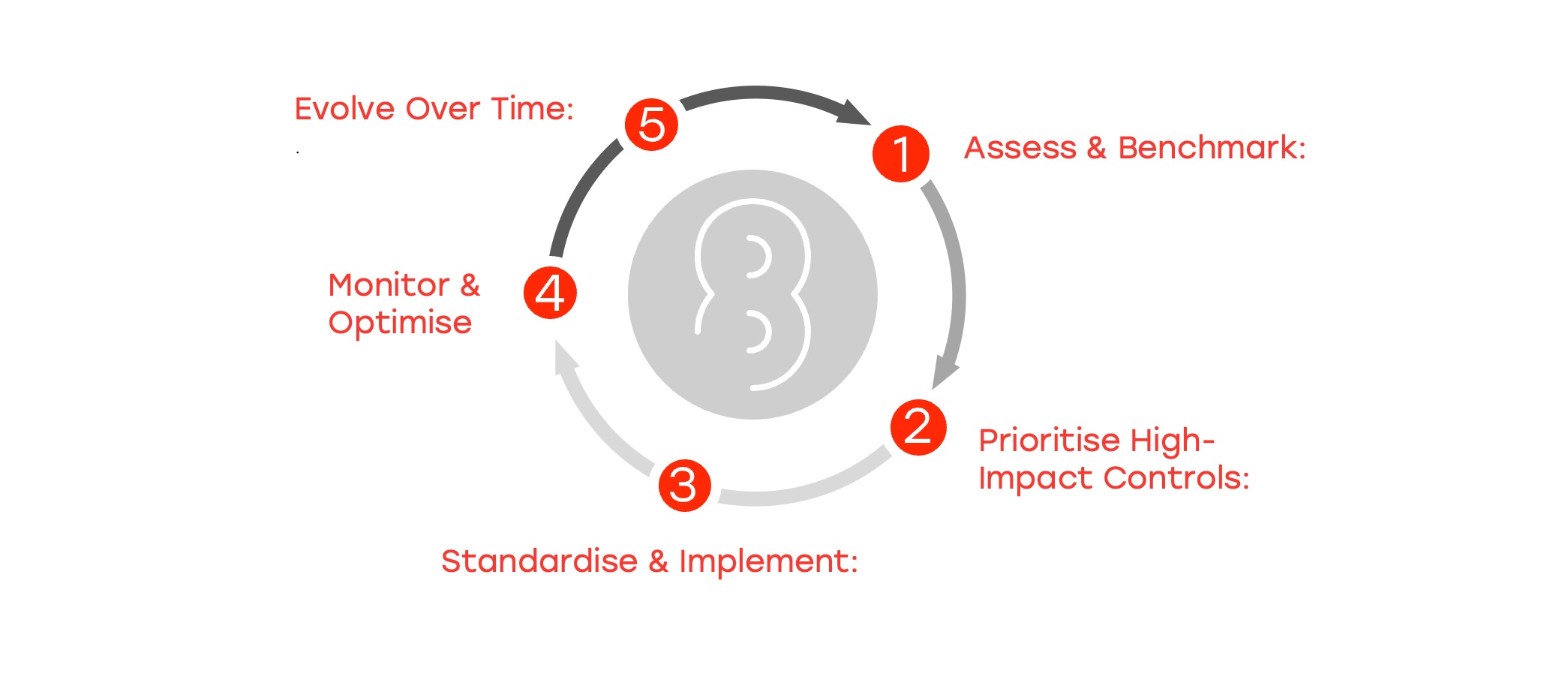
1 – Assess & Benchmark
The first phase focuses on gaining visibility across the organisation’s current environment. This includes evaluating existing security controls, identifying gaps, understanding risk exposure and benchmarking the organisation against Essential Eight maturity levels.
Establishing a clear baseline provides the insight needed to prioritise improvements effectively and create a realistic roadmap for uplift.
2 – Prioritise High-Impact Controls
Once visibility has been established, organisations can focus on the controls that will deliver the greatest immediate reduction in risk. This often includes strengthening areas such as patch management, multi-factor authentication, application control and privileged access management.
By addressing critical vulnerabilities first, organisations can achieve early security wins while building momentum for broader transformation.
3 – Standardise & Implement
The implementation phase focuses on rolling out consistent policies, controls and security processes across systems, users and devices. Standardisation helps reduce complexity, improve governance and create a more manageable security environment.
This phase may also involve integrating security controls into existing platforms and automating processes where possible to improve efficiency, visibility and long-term operational consistency.
4 – Monitor & Optimise
Cyber security is not static, and neither are modern business environments. Organisations must continuously monitor the effectiveness of controls, track compliance, assess emerging threats and refine policies as requirements evolve.
Ongoing optimisation helps ensure security investments continue delivering value while maintaining alignment with operational objectives and maturity targets.
5 – Evolve Over Time
The final phase focuses on long-term resilience and continuous improvement. As technologies, threats and business priorities change, organisations should continue reviewing and enhancing their security posture over time.
Rather than viewing Essential Eight as a one-time project, mature organisations embed security into ongoing operations and strategic planning, allowing security capabilities to evolve alongside the business.
Building a Stronger Security Foundation
A structured migration strategy helps organisations reduce complexity, minimise disruption and achieve meaningful security improvements in a controlled and sustainable way. Breaking the journey into manageable phases allows organisations to prioritise risk, maintain visibility and deliver measurable progress over time.
Most importantly, it creates a stronger, more resilient security foundation that supports the organisation both today and into the future.
With the right strategy, governance and partner support, organisations can move beyond reactive security measures and build a modern cyber security framework designed for long-term confidence, resilience and operational success.
Summary
Achieving Essential Eight alignment is not simply about implementing a set of security controls and considering the job complete. It is about establishing a stronger security framework that can adapt, mature and evolve alongside your organisation. As technologies change, new threats emerge and business requirements develop, security controls must be continually reviewed, monitored and strengthened to ensure they remain effective.
By following a clear and structured pathway, organisations can turn what may initially appear to be a complex and resource-intensive security challenge into a manageable, measurable and achievable journey. Starting with a clear understanding of the current environment, prioritising the areas of greatest risk and progressively implementing the right controls allows security improvements to be introduced without unnecessary disruption to day-to-day operations.
Just as importantly, the journey does not end once the initial controls are in place. Continuous monitoring, reporting, governance and optimisation help organisations maintain visibility over their security posture, identify emerging gaps and demonstrate measurable progress over time. This creates greater accountability and ensures security investment continues to support both cyber resilience and broader business objectives.
With the right strategy, processes and experienced partner support, the Essential Eight can become far more than a compliance exercise. It provides a practical foundation for reducing cyber risk, protecting critical systems and data, improving operational resilience and creating greater confidence across the organisation. Ultimately, a structured Essential Eight approach helps organisations build a security environment that is not only stronger today, but better prepared for the threats, technologies and business challenges of tomorrow.